Credo Light
Part 2
Attributes of Appreciation
Overview
Languages of Appreciation
The Importance of Meaningful Appreciation
Languages of Appreciation
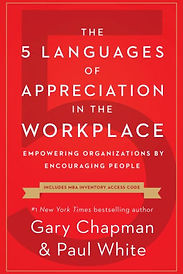
At work, people express and receive appreciation in different ways. If you try to express appreciation in ways that aren’t meaningful to your co-workers, they may not feel valued at all. This is because you and your co-workers are speaking different languages. It is important to understand that one method of employee recognition isn’t universally accepted for all employees. Knowing their languages of appreciation can help your company keep employees motivated by offering the right type of encouragement and the rewards that they’ll appreciate most.

Language No. 1: Words of affirmation
According to Chapman and White, these "words" could be spoken or in writing. Examples include sharing a handwritten note specifically calling out the recipient's actions and recognizing them at a team meeting. In terms of the latter, this might involve summoning the team member to the front of the room and verbally praising their performance.

Language No. 2: Quality time
In the workplace, quality time could include stopping by a co-worker's desk to ask how things are going or inviting them out to lunch. But quality time doesn't always have to be lengthy, personal chitchats. Asking for someone's professional opinion or feedback could also be perceived as appreciation.

Language No. 3: Acts of service
People who speak this language likely feel frustrated if their boss says, "Hey, you're doing great!" and then walks away. To them, words are nothing; actions are everything. Showing appreciation to these team members might include an offer to take something off their plate or work alongside them on a demanding project.

Language No. 4: Tangible gifts
Of course, like any gift, the more closely aligned it is with the recipient's preferences, the more powerful it will be. It doesn't have to be extravagant. For instance, if your co-worker speaks this language and loves vanilla lattes, a meaningful show of appreciation might be to bring them one at the office. Or, if their favorite band is playing a show in town, giving them tickets might convey appreciation more strongly than anything else.

Language No. 5: Physical touch
In their assessments, Chapman and White never found "physical touch" to be anyone's primary language of appreciation in the workplace. For this reason, it doesn't even show up in the list of assessment results. But, the authors agree that some identify with this language and that these individuals would likely perceive a high-five or pat on the shoulder as a gesture of appreciation.
The Importance of Meaningful Appreciation


“The degree to which employees feel appreciated is one of the core factors Gallup researchers found to significantly impact the level of employee engagement in organizations.”
-
Rodd Wagner and James K. Harter, The 12 The Elements of Great Management (New York: Gallup Press, 2006)
More about the numbers gathered from Gallup.
-
Improving the levels of praise, recognition, and approval leads to an increase in productivity and revenue between 10 – 20%.
-
The highest-performance teams had 5.6% times more positive comments than negative remarks.
-
Only 6% of employees identify tangible gifts as the primary way they want to be shown appreciation (trophies, plaques, or certifications).
-
A global study of over 200,000 employees stated the most important factor related to enjoying their job was that they felt appreciated.
-
Only 12% of employees reported leaving for more money, while 88% of employees left for other reasons, like note feeling valued or trusted.
-
When reviewing over 90 studies over a period of 120 years, the relationship between salary level and job satisfaction, with how much they enjoy their work, is 2%.
-
“Companies that provide ample employee recognition have 31% lower voluntary turnover rates.”
-
“At one large medical facility, increasing recognition of employees led to an increase in patients’ rating of their experience by 11%.”
The Disconnect
-
The Effort
-
Retaining quality employees has been identified by 87% of HR professionals as the highest priority of their profession.
-
-
The Result
-
79% of employees who leave their jobs cite a lack of appreciation as a key reason.
-
Turnover has cost the US Economy at least $5 trillion a year.
-
What is Appreciation?
-
A feeling or expression of admiration, approval, or gratitude.
-
A Judgement or Evaluation.
-
Sensitive Awareness
-
Increase in Value
Appreciation starts with awareness.
Having an outward mindset.
-
Do you see someone as a problem, a solution, or a person?
-
Is appreciation objective or subjective?
-
Objective: Impersonal – A problem or solution.
-
Subjective: Personal – A person.
Difference between Recognition and Appreciation
-
Recognition: What they do – the problem they are or the one they fix.
-
Appreciation: Who they are – Despite being the problem or the one they fix.

Performance Based
Allows the organization to celebrate big wins together.
People may keep acting, perhaps without knowing why it matters.

Value Based
It shows you appreciate them despite the bad day they may be having.
They know what it is that you value and why.
Did Phillies fans fix Trea Turner?
-
Did the fans see the player, or his statistics?
-
What did Trea feel like before the appreciation?
-
An individual contributor
-
Isolated
-
A failure
-
-
How may he have felt after?
-
Accepted
-
A member of the team
-
Allowed to fail and keep trying
-
Blindspots
Appreciation on Auto Pilot
Your highest is your default.
-
This is how you will express appreciation to others.
Your lowest is your blind spot.
-
Someone may express appreciation, and you won’t notice.

Change
Your primary language of appreciation can change over time, or with something that changed your life.
-
Getting married
-
Having kids
-
Overcome a life-threatening illness
-
Changing careers
Your language can change depending on the person and circumnutates.
-
Someone you know well or have just met.
-
After a big project or a goal was reached
Breakout
-
What is your default, and what is your blind spot?
-
Have there been times when someone may have shown you appreciation in your blind spot that you missed?
-
What are some other reasons why someone's primary language may change?
Why is Appreciation so important?
Appreciation Drives Culture
Motivation:
What I do here matters to those around me
Engagement:
I respect those I work with, and they respect me because they see me as a person.
Culture:
People enjoy those they work with and can let down their guard to create their own culture and traditions.
Who do we want to receive appreciation from?

Meaningful
-
Raises job satisfaction
-
Raises customer satisfaction
-
Lowers costs
-
Employee retention
Job satisfaction is greatly affected by whether we feel our work is valued and appreciated. Most employees also want to express and receive appreciation, but many don’t know how. Effective expression of appreciation is not just for supervisors and managers but for any level in the organization.
One of the highest organizational costs is staff replacement. Besides the tangible costs like termination, advertising, recruiting, selection, and training, intangible costs like the temporary loss of efficiency, impact on morale, and customer relationships. This is especially so since the team members lost are usually the most talented and capable. When employees are satisfied, they are less likely even to consider leaving their current jobs. Higher employee satisfaction is also correlated with higher customer satisfaction, which is key for business success.
Meaningless
-
Embarrassment
-
Stress
-
Anxiety
-
Miscommunication
We all know at least one high-performing employee who doesn't like the spotlight. To them, receiving an award in front of the department or the entire company can be a nightmare. Those who enjoy the spotlight, or don't mind it, will have a had time understanding this and may think that employee needs to be "brought out of their shell." But why would a supervisor think that if they need that if their employee is are already performing at a high level?
The chances are that the supervisor likes the spotlight, and to them, receiving an award in front of their colleagues would bring them a great amount of satisfaction and proof that they are valued. In this case, the supervisor incorrectly assumes that the employee shares their value of public words of affirmation.

Learning How to Show Meaningful Appreciation

Learning your own most valued language of appreciation is often the best way to understand how different languages will have different values to different people. Once you take the test and see that there is usually one language far higher than the rest and that usually, at least one language has almost no value to you in the context of feeling valued and appreciated, the concept will tend to click.
The second step is being familiar enough with the other languages to recognize when someone shows it. Many unintentionally express appreciation in the way they want to receive it. Once you are familiar with the general principles of all the languages, you will be able to see others' most valued language of appreciation in how they try and show appreciation to you. If you have a coworker who always brings you small gifts after you covered for them or stayed late to help them hit a deadline, you will recognize gifts as their most valued language of appreciation.
Of course, the best way to find out someone's most valued language of appreciation is to ask them. An easy way to ask someone is to let them know you would like to show them your appreciation and value their work on the team by taking the same test you did and offering to share yours with them.
Putting the Concepts to Work

The book ends with many tips on how to put the five languages to work. Here’s a synopsis of some of the key ideas:
-
Start by identifying your language(s) of appreciation and those of your colleagues to avoid using the “wrong” mode of appreciation.
-
Be aware of the shifts in your primary appreciation language over time, context, or during critical life events (e.g., loss of a loved one).
-
The book also addresses several challenges that must be overcome for meaningful workplace appreciation (e.g., busyness, lack of belief, personal discomfort, lack of genuine appreciation for your team members).